Wednesday, September 11, 2019

Baseball Card Collecting Memes (Japan Edition)


Baseball card collecting memes for those of us collecting Japanese cards.


Tuesday, September 10, 2019

Colors! Minoru Murayama Menko


This is another recent pick up: Minoru Murayama's 1959 Maruya JCM 69 Menko.  Murayama was one of the top pitchers in Japan in the 1960s, winning three Eiji Sawamura Awards (Japan's equivalent of the Cy Young Award) and compiling 222 career wins, all for the Tigers.  He was inducted into the Hall of Fame in 1993.

This card really appeals to me.  A lot of menko from that era used colorized black and white photos which sometimes result in very weird color combinations.  This is one of them. I assume that whoever was colorizing the pictures just had the black and white image to go on and had no idea what color everything in the photo actually was.  Did Koshien Stadium really have pink walls back in 1959?  Or orange grass?  Were Tiger hats blue?  Did Murayama wear a green long sleeved shirt under his jersey?

I'm pretty sure the answer to all of these is no, but the oddball color selection really makes this card speak to me, way more than an actual color photo would.

The back is also cool, it shows you how to hold the ball when you throw a slider.
Engel lists this set as R3, meaning less than a hundred known copies of each card exist.  I have a couple other cards from the set  but its going to be a tough one to complete (it has a very expensive Sadaharu Oh rookie card in it).  The set collector in me really wants to work on completing some of these menko sets from the 50s and 60s, including this one, but financial realities are going to collide with that ambition.  Still though, the lull in 1975-76-77 Calbee cards that I need coming up for auction is allowing me to focus a bit more on getting these beauties and I feel almost like I'm having a secret affair with them behind Calbee's back.  I'm definitely not a philanderer in my real life relationship (happily married for 16 years) but my card collecting persona seems to lend itself to falling in love with whatever colorful object is dangling before me at a given moment.  Right now its menko cards.

Sunday, September 8, 2019

1977 Path to Stardom: Featuring Stars Then and Slightly Before Then

 I haven't really been working on the 1977 Calbee set like I am with its predecessor, the 1975-76-77 Monster.  The 77 set is way more confusing since it is really several different sets, each of which they start the numbering again from "1" with.  The first of these (numbered to 216) really threw me off when I started seriously organizing my 75-76-77 set since the design of the cards, front and back, is identical and it took me a while to figure out that some of the cards which I though were part of my monster set were actually part of the 1977 set, which wreaked havoc on my checklist!

But since I've hit a wall with my monster acquisitions, I've also been picking up the odd card or two from the 1977 set.  One series from it which I thought was interesting is this one "Path to stardom" (numbers 73 to 109 in the confusing first set with the same design as the 75-76-77 set that cause me so many problems).

I have a couple of cards from it, featuring Dragons star and Meikyukai member Kenichi Yazawa (above) and Tigers star catcher Koichi Tabuchi below.  As you can see, the cards have two photos, a "now" one in color and a "then" one in black and white.


There is a similar series in the 75-76-77 set which has the same "Path to Stardom" name and also features the dual photo look.  That one is more like the "Boyhood photos of the stars" series that Topps put out in the 70s, featuring a picture of the player as a kid.

These 1977 ones though the "then" picture is one from their rookie year in NPB.  Its kind of odd, since neither of these players were exactly grizzled veterans when these came out: Yazawa had debuted 7 years earlier and Tabuchi 8.  The black and white pictures thus aren't ancient history, but just a few seasons old and for all anyone knew could have been contemporary with the set (except some uniform updates).

Its kind of a cool set though, these are a nice break from the full bleed photos of 1970s Calbee sets.


Thursday, September 5, 2019

Weird and Disappointing Packs: 1976 Mitsuya


I made another impulse purchase on Yahoo Auctions.  I'm way over budget and need to stop.  But these things keep popping up and I can't.

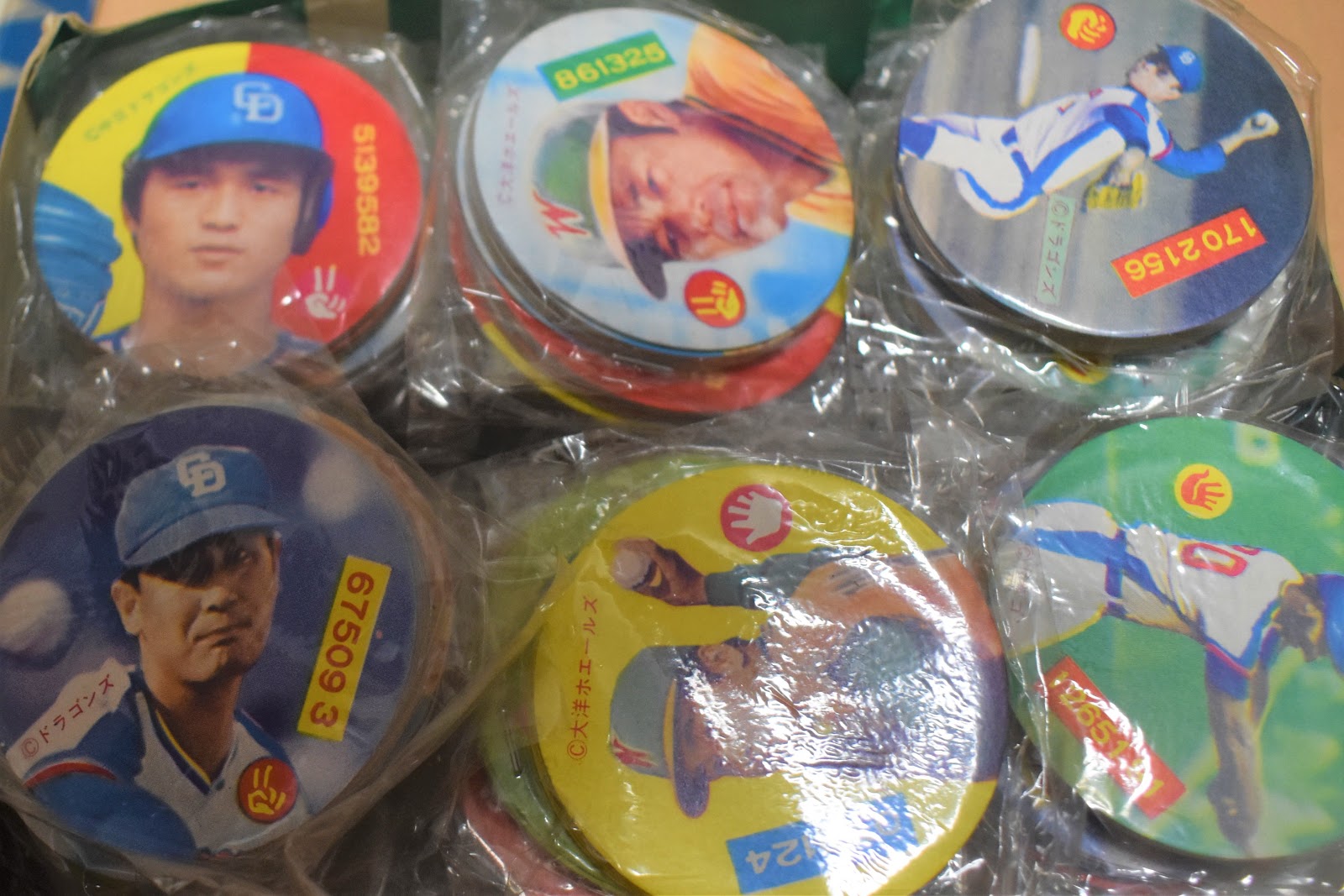
There was a whole unopened box of 1976 Mitsuya Cider baseball menko (JRM 10) up for sale, how could I not put a bid on it?  Look how pretty they are, wouldn't you bid too? Even if, like me, you didn't really know what they are until you saw them for sale?

Anyway, now they are in my house.  

This is actually the weirdest, and most disappointing, unopened box I've ever gotten.  As the box top (which is pretty cool) says, it has 60 packs which were sold for 10 Yen each back in the day:
So far so good.  And take the lid off and you see a bunch of packs of menko wrapped in clear cellophane, each holding 8 cards.  
Wow, look at how exciting those look!  So colorful and what a variety of players!  No problems at all, I am totally satisfied with this purchase!!

But wait.  Lets pick up one of the packs and then.....things get real weird real fast.  Let me demonstrate by picking up this pack with Masaji Hiramatsu visible on the front.
Notice anything odd?  Like how every single one of the menko in that pack is the same color?  That is because they are all the same: 1 pack with 8 Masaji Hiramatsu cards in it!

I looked through every one and they are all the same: each pack contains 8 of the same card!  And I have many packs with the same player (5 Senichi Hoshino packs for example means I now own 40 1976 Mitsuya Cider Senichi Hoshino cards).

These are all the packs:
I note that this is a really small set: there are only 22 cards in it.  This box has 464 cards from that set in it.  But I can't make a single set!  The 22 cards seem to have been issued in two series, and this one only has one of those in it.  So I have 464 copies of 11 different cards!

This turned out to be way less fun than I thought it would be when I opened the box.

Also, one of the packs isn't even a baseball card its.....whoever this is:
Hope he is good, because I now have 24 of him.

This whole thing is just bizarre on so many levels (welcome to Japan....)  I mean, what kid in their right mind would have bought these back in the day?  Its not even hidden that each pack has 8 of the same card, you can plainly see it when you hold one up.

Mitsuya issued a few baseball menko sets like this in 1976 and, being new to the biz, I guess they just weren't very good at it (hence them only lasting the one year).  I mean, how hard would it have been to put 8 different cards in one pack???

So yeah.  This is now mine.  And I'm having some buyer's remorse, though fortunately it didn't cost me too much.

Tuesday, September 3, 2019

My Sadaharu Oh Rookie Card

Voila!  I have a Sadaharu Oh rookie card!

Since picking up the Engel guide a couple months back I've gotten a lot more into the old menko cards and I figured adding an Oh rookie to my collection was an obvious thing to do because....Oh.  Keeping up with the Jones's and all that. Well ,actually there aren't really any Jones's in the Japanese card collecting world to keep up with (the benefit of being in a niche hobby), but I wanted one anyway.  So I started scouring Yahoo Auctions looking for a nice one.

The problem with getting a Sadaharu Oh rookie card is that there are a lot of them.  1959 was the height of the tobacco sized Menko set era and they pumped out quite a few with Oh that year, so if you are looking for one you have a lot to choose from.  Many of them are attractive with vibrant colors and cool pics of a young Oh, which further complicates the choice.

I went for the green one, for no other reason than I like green, love the look of the card overall and it was the one that happened to be available at the time.  It is from the 1959 Doyusha set which Engel catalogues as JCM 30b.  According to this article on Sports Market Report from last year its one of his most famous, and also available, rookie cards.  Engel ranks the set at R1, meaning between 250 and 1000 copies of each card are known to exist.  By American standards that would be extremely scarce, but by Japanese menko standards it puts it among the easier to find.

The back of the card is printed in blue ink, and has the Giants logo and Oh's name and position on it, along with a rock-paper scissors game and number.  Mine also has a purple splat on the left side of the back.  I think this was a mark by the manufacturer put on some cards which identified them as redeemable for a prize or something.  A lot of menko have stamped marks like that for that reason, though I'm not 100% sure, usually they have a number or something but mine is just a splat.


This set me back about 10,000 Yen (100$) with shipping, so its one of the most expensive Japanese cards I've ever bought, but I think worth it.  I guess having so many different rookie cards keeps the price of any one of them quite reasonable despite him being the home run king and there being so few of them.  Its also one of those things where there is an odd lack of demand in Japan for something that is so popular overseas: looking at past auctions these seem to sell for a lot more in the US.

Other than the splat, this card is in surprisingly nice condition.  These were hand cut from sheets back in the day so the borders are not 100% straight, but pretty good compared to the butcher jobs I've seen on some.  There are no creases or even much corner wear either, it would probably grade about Ex or so (except for the splat).  I say its surprising because in my experience there are very few menko from this era which exist in mid grade condition like that.  Owing to the nature of the menko game, they are usually either completely destroyed, or in pristine mint condition still uncut from their sheets.  Once kids cut them from those sheets, they usually got thrown around like crazy!


Monday, September 2, 2019

Some 1976 Pepsi Dragons


Another day another Yahoo Auctions pick up.

I got these four from the 1976 Pepsi Chunichi Dragons Round Menko set (JRM 13 in Engel).  I had picked up seven others from the set earlier this year, so these give me 11 in total.  I really love this set, the bold colors and gold foil give them a really striking appearance.

I'd like to complete this as a set, but I'm a bit unsure of how many there are.   Engel says there are "60 +" cards in the set, implying there may be some not in the catalogue.  He also only lists 29 players and two team logo cards, but most were issued with different colored ink on the back, either in pink, brown or violet, which I think gets you to 60 cards with those variations.  The four cards I got in this lot were all brown ink backed, though the ones in my earlier acquisition came in a variety of colors.


Fortunately these new additions contained the card of Hall of Famer Wally Yonamine, who managed the Dragons from 1972 to 1977.  He is of course also famous for being the first American inducted into the Japanese Hall of Fame.  I only had one old bromide of him, so I'm glad to add a menko featuring him to my collection. According to Engel his card is the most valuable in the set.

I also got Morimichi Takagi, another Hall of Famer (and recent Dragons manager) in the lot too, which is kind of cool.  Takagi's card is the only one that doesn't say "Pepsi" or "Pepsi-Cola" on it, but instead "Patio" which I assume was another soft drink that Pepsi sold in the 70s (doesn't exist today!)

These were a pretty huge steal, just 500 Yen (about 5$ US) for the lot! The Yonamine alone books for 35$ in Engel, so this is another one of those "Japanese under appreciating their old cards as reflected in how cheap they sell for" things.  The Yonamine does have a small crease in it but otherwise they are in pretty nice shape.

Sunday, September 1, 2019

1935 Koshien Postcard


I picked up this postcard off of Yahoo Auctions last week.  It is a colorized photo of a scene from the 21st Japanese High School Baseball Championship, held at Koshien Stadium each year.  This is the 1935 event and the scene depicts a player from an un-named team laying down a bunt.  Matsuyama won the championship that year, but I have no idea if this is from the final game or from a game with other teams earlier in the tournament.  I really loved the scene which is why I bought it (there are a lot of pre war baseball related postcards but most of them are kind of boring to look at).

This one was actually sent to somebody, judging from the postmark it was sent in October 1935 from the post office in Hirano.  There are several places by that name in Japan but I think Hirano ward in Osaka, which is not far from Koshien, is the most likely.  The handwriting on the back is very difficult to read so I'm not sure what the message is (something about being on a mountain the other day but that is about all I could make out).

The postcard was printed by the Asahi Newspaper company, which sponsored the championship.  Not sure if this was distributed through their newspaper or perhaps sold in stores or at Koshien.  The red stamp on the back is what tells us it was from the 21st Championship.

I think I might frame this to put on the wall, it looks pretty cool!