October 14, 1974 was the last day that Shigeo Nagashima played a baseball game. The Calbee set that year produced a few cards in the Oh/Nagashima (ON) series which commemorated the occasion since it also marked the end of Sadahauru Oh and Nagashima appearing in the same lineup. The end on an era.
Card 426 in the set is one of the more interesting ones. It shows Oh presenting flowers to Nagashima at the end of the game (the Dragons Yasunori Oshima is on the right, having also given Nagashima some flowers) Its a kind of neat picture, with all those 70s photographers in the background.
The back of the card says;
“At last the time for Mister to put down his bat. Everyone knew that this day would come, but hoped that it would last another year or two. At the end of the game on October 14, 1974 at Korakuen, Oh presented him with flowers on behalf of the Giants, Oshima on behalf of the Dragons.”
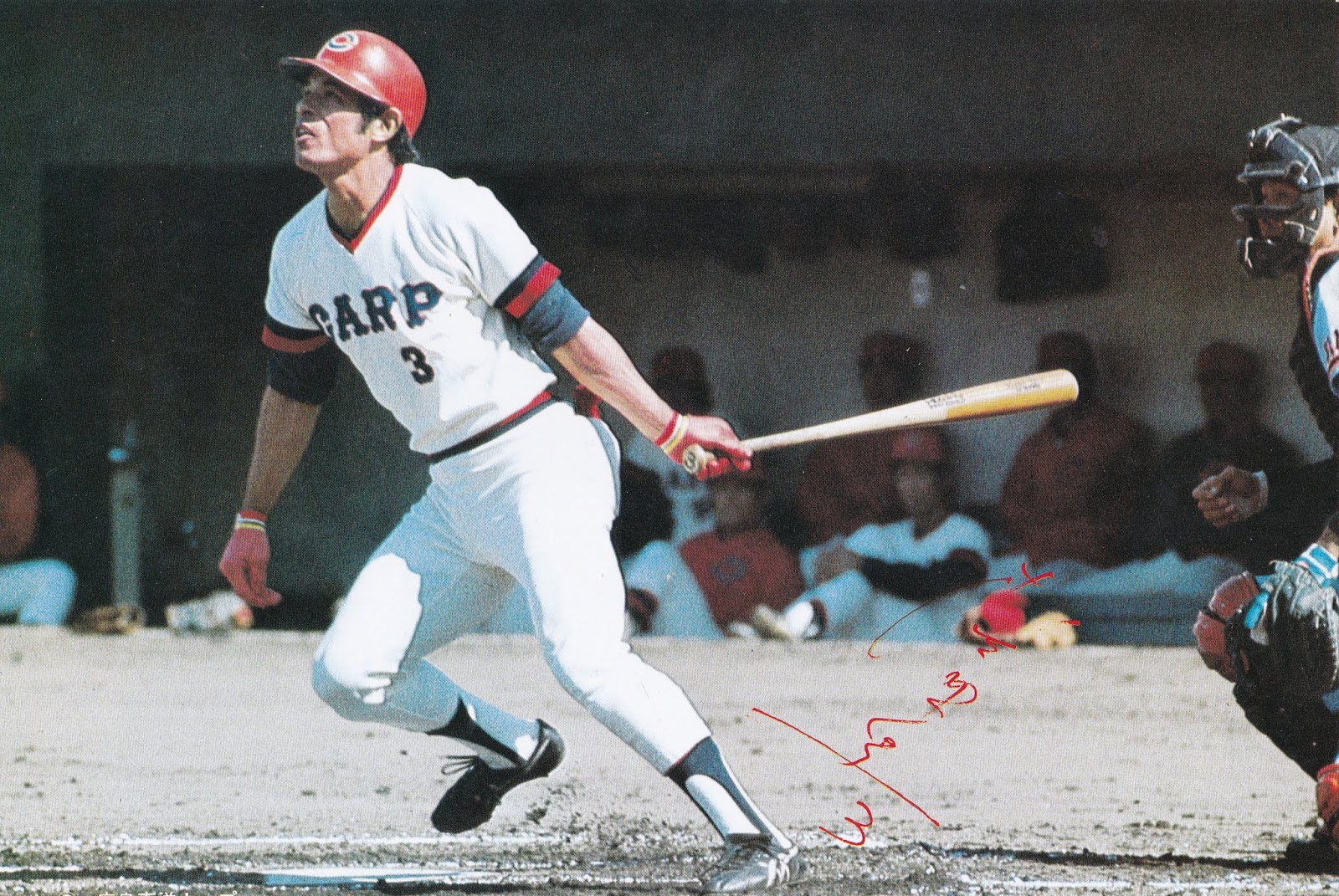
I was going through some boxes the other day and pulled out something I had almost forgotten that I had. Its card number 7 from the 1973 Calbee set featuring Sadaharu Oh. Its one of his first Calbee cards and, with him silhouetted against the blue sky, pairs up nicely with the first card in the set featuring Shigeo Nagashima.
Mine is autographed.
I didn’t get the autograph in person, rather this was something I bought on impulse several years ago. I don’t often buy autographed cards since I’m not good at detecting forgeries, but this one had a pretty decent provenance. I bought it from Biblio, a famous store in the Jinbocho neighborhood in Tokyo that is probably the leading dealer of vintage baseball memorabilia in Japan. The owner is known in Japan as one of the leading experts on baseball autographs and has appeared on a TV show that I watch every Tuesday called Nandemo Kanteidan, which is kind of a Japanese version of Antiques Roadshow. Regular people bring their antiques and experts tell them if they are valuable authentic pieces or worthless fakes.
So if I see something from them, and it looks good to my amateur eyes, I figure its probably good. I didn’t go to the store in person (Dave has visited twice and has written about what the actual store was like, including a complaint on his last visit), but rather picked it up from their online store.
I bought it before the pandemic hit and the price of vintage stuff, and especially Sadaharu Oh vintage stuff, took off so I didn’t pay that much for it. I rather like autographed vintage cards and couldn’t resist this one in particular. It got kind of mixed up with some other stuff after I got it, something that often happens with oddball items in my collection that I don’t have a “category” in my rudimentary sorting system for. I was happy to find it.
At heart I am a set collector. Mainly old stuff. Almost all of my collection is cards from sets I am, with varying levels of intensity, pursuing. This is sort of a default setting for me. Most of these are sets I’ll never seriously go after, but if I have at least one card from a set, the remainder are ones I’d like to have.
Until recently it was relatively easy being a set collector in Japan because most sets didn’t have any insanely valuable rarities to discourage you. There are a few exceptions, like 1967 Kabaya Leaf or 1973 Calbee which have some hyper rare short prints but otherwise there were a lot of do-able sets out there (well, at least if you live in Japan where its easier to find them).
Over the past couple of years though this has quickly changed. Us set collectors now have a Sadaharu Oh problem.
In Japan, like the US, the pandemic led to a surge in prices on vintage cards. Here though the price bump has fallen disproportionately on a single player’s cards. Sadaharu Oh card prices have gone through the roof, with many increasing in price 5 to 10 fold over 2019 prices.
To give one example, I paid about 10,000 Yen for my JCM30b Sadaharu Oh rookie card in 2019, which was about normal. Today that card goes for about 10 times that much, if you can find one. Other examples abound.
I’m extremely glad I was able to buy that Oh, and a few others, when I did because as it stands now I have been completely priced out of the market on any Oh menko at all, not just his rookies. As a set collector though this price rise has completely destroyed my menko collecting goals since there are quite a few other sets I was working on but hadn’t acquired the Oh yet. Now those are all dead ends.
The Oh price explosion has annoyingly also affected his Calbee cards from the 70s too, which have gone up quite a bit. A few years ago his cards (and those of other major stars) only commanded a small premium over common prices since there were so many of them. Now Oh cards sell for a noticably higher price. Fortunately this isn’t forcing me to abandon my set collecting goals for Calbee cards since the starting point for those cards was way lower. With some exceptions I used to be able to easily get his cards from the 1975-76-77 monster set that I’m working on for 200 to 300 Yen each. Now they are usually in the 700 to 1000 Yen range. More expensive, but still within my budget at least. It helps that the hyper rare cards from most Calbee sets in the 70s were in series that didn’t include Giants players, so no Oh card is too rare, though there are a few 1977 and 1978 cards of his that are quite expensive now.
I do wonder if this Oh price explosion will cause some tension among Japanese collectors. Its pretty obvious that most of this movement is due to Americans buying up his cards and not domestic collectors. I can still buy menko of Hall of Famers whose names are unfamiliar to Americans for insanely cheap prices, but the one guy whose name gets checked in a Beasty Boys song is the only one in the stratosphere. Not hard to put two and two together.
Vintage Oh cards are a finite resource that Japan seems to be exporting at a high rate, meaning the remaining supply for domestic set collectors is getting smaller and smaller. The number of such set collectors is small, but then again so is the number of such cards. I was lucky to start collecting when I did, I think if I was trying to start a collection today I’d have taken one look at those Oh prices and walked away. Well, maybe not walked away, but at least have limited my collecting way more than I did.
I got a pretty cool thing in the mail from Gregory at Nine Pockets the other day - a stained glass window style card of Sadaharu Oh which he put together.
The card is based on Oh's menko in the JCM 165 set from 1975, which I posted about a little while ago and was the inspiration for this card. Gregory was kind enough to send one to me solely based on having seen the original card in my post, which was very nice of him.
The original card is quite distinctive with that halo like sun (or whatever it is) behind Oh's head:
The above is card #480 from the 1974 Calbee set. Its from the "ON" series which features various pictures of Sadaharu Oh and Shigeo Nagashima.
According to the back, the photo is not from 1974 but rather from 1960, early on in both player's careers.
This one came up for auction last week and I put a few bids on it but got totally blown out of the water, it ended up selling for 36,501 Yen (about $350 US), way over my budget. This is further evidence that the price of cards has exploded here like they have in the US, a couple of years ago this would probably have been a $50 card.
I really just wanted it for my "weird stuff on cards" collection because this one is a doozy. I mean this is pretty in your face stuff in terms of having a card blatantly depict players modelling bad behavior for children on a product that was meant for children. Hey kids, look at how cool Shigeo Nagashima is when he smokes cigarettes! I mean, I get that this card is old and views about smoking have changed a lot over the past 50 years but I think even in 1974 it should have been obvious that maybe this wasn't a great image to be showing kids. It makes me wonder if Calbee had been producing cards during the PED era if they would have made a topical subset showing candid behind the scenes images of players injecting each other with human growth hormone or something like that.
The card is interesting also because it makes Sadaharu Oh look pretty subservient. It reminds me of a quote by Hiromitsu Ochiai, who was a bit of a renegade player (that I talked about in my previous post). Early in his playing days he quit his university team because he hated the way that junior players were expected to light the cigarettes of senior players and basically dote on them. As he explained: "If I'd wanted to be a nightclub hostess, I'd have gone to work on the Ginza" (quoted in You Gotta Have Wa). Oh came up a year after Nagashima and it would seem from this card that he was expected to perform nightclub hostess related activities for Nagashima as a result, despite not working in Ginza. Ochiai wouldn't have gone for that at all.
Out of curiousity, does anyone know of any other examples of cards (in the US, or anywhere, any sport) depicting players modelling bad behavior for kids?
For reference, here is some other oddball stuff that has appeared on vintage Japanese cards:
I picked this card up the other day. It is card #50 from a 1977 Calbee set dedicated to Sadaharu Oh in commemoration of his 756th home run. I've written about this set before, its pretty scarce so I only had a couple of cards from it before adding this one. I was pretty happy to win this one for a reasonable price given the apparent explosion in the price of some 1970s Calbee cards recently.
I liked the photo on the front of the card which according to the text on it is from the post-game ceremony held after he hit #756. When I say "like" I don't necessarily mean that it is a great photo, but its an interesting one. The player depicted, Oh, is dwarfed by the backs of four old guys in suits, who I assume to be Yomiuri executives. Not many cards feature such an odd composition.
The highlight though is the cool shot of that scoreboard with the message "Congratulations player Oh for #756" and a crude rendition of his head next to it. There are a few Calbee cards from the 70s which prominently feature that scoreboard in the background commemorating some major milestone, usually of either Oh or Shigeo Nagashima, which would make for an interesting collecting sub-set.
The back of the card is kind of interesting. It shows the 15 pitchers who Oh hit the most of his 756 home runs off of. The most were 23 he hit off of Hiroshima Carp pitcher Yoshiro Sotokoba (who was elected to the Hall of Fame in 2013 (despite having a career record of 131-138). This is only through home run #756, I'm not sure if Sotokoba maintained that lead through the rest of Oh's career.
I've been AWOL from the blog for the past few weeks. October is kind of "hell month" for me at work so its been hard to squeeze time in for blogging.
Despite that, the flow of card purchases by me has continued more or less at its normal pace. One card I picked up this month was the above, #354 from the 1981 Calbee set. It is basically Sadaharu Oh's regular card. His name is the one in pink lettering on the lower right of the photo, and the text on the back just gives some general biographical information about him, unconnected to the photo.
This card is really neat though. From left to right you have Motoshi Fujita, Sadaharu Oh and Tatsunori Hara. Those three guys have three big things in common:
1) They were all star players for the Giants;
2) They all became managers of the Giants after their playing days (Hara is in fact their current manager)
3) They all ended up in the Hall of Fame.
I'm not sure but I think the photo was probably taken during the 1981 Japan Series, which the Giants won (Fujita was the manager, Oh was assistant manager that year and would take over as regular manager the following season).
A second, and more important, neat thing about it specifically relates to Tatsunori Hara, the guy on the right. 1981 was his first year in pro ball and he was THE hot rookie that year. He was supposed to be the Giants' next Shigeo Nagashima or Sadaharu Oh. His playing career, which ended in 1995, didn't quite live up to that hype, though he did bang out 382 career home runs and was one of the better players in NPB throughout the 1980s.
The thing is though, Tatsunori Hara doesn't have a card of his own in the 1981 Calbee set. His first "solo" appearance on a card came in the 1982 Calbee set, which is generally regarded as his rookie (he appears on a few cards in that set, my old Sports Card Magazine designates the first one, card #51, as his true "rookie card").
His cameo appearance on my 1981 Calbee card though seems to be his first appearance in a Calbee set. Which leads me to the question: what is this card? I guess its not a "rookie card" since its not his card, its Sadaharu Oh's. But at the same time, Hara is pretty prominently featured on there so its a bit more than just a card of some other player where he coincidentally appears in the background or something, like Ryne Sandberg's cameo on Reggie Smith's 1983 Topps card:
Also, Sandberg of course had a card of his own in the 1983 Topps set, so the question of whether his appearance on the Smith meant something special didn't really come up.
So this card falls into a weird limbo in terms of what the hobby might designate it as since I don't think there is a precedent for this. Its definitely not a true rookie card, but also definitely not nothing either. "Pre" rookie card? No, thats not right. I can't really decide what to call it. Anyway, its neat.
One of the hardest Calbee sets from the 70s to find is the 96 card set dedicated entirely to Sadaharu Oh on the occasion of him passing Hank Aaron's 755 career home run total.
I only have 2 cards from this set, number 38 and 42. The card above (#42) features a photo taken at exactly 7:10 PM (and 7 seconds!) on September 3, 1977 as the text on the card front tells us. It shows him high fiving Giants coach Akira Kunimatsu while rounding the bases after hitting #756.
The back of the card is kind of interesting. It shows some stats on each of his milestone home runs over his career that you don't often see. For each, in addition to the date, it also tells you how many other players had hit that many (at the time), the pitcher he hit it off and the number of games it took to get there. So we can see for example that when he hit his 100th career home run on July 28, 1963 off a Hiroshima pitcher named Ooishi there were only 32 other players in the NPB "100 home run club". When he hit #200 a mere 2 years later there were only 12 other players with as many. Two years later he joined the 300 home run club, which only consisted of 3 players. And when he clobbered #550 five years after that he was in a club all by himself. There seems to be an error in the last two entries of the number of games played column, it seems highly unlikely that it took him 2318 career games to reach 715 home runs, but didn't reach #755 until career game 10,145 (which would take about 70 seasons).
Card #39 is also pretty neat. It shows him on August 31, 1977 being interviewed after tying Aaron with his 755th home run.
The back of this card is also pretty cool, it shows a side by side comparison of the careers of Oh and Aaron from 1954 to 1977. The first few years are blank for Oh since he didn't play his first game until 1959, while 1977 is blank for Aaron since he retired after the 1976 season. Its actually quite impressive that Oh accomplished his feat in four fewer seasons than Aaron, especially given the shorter season in NPB.
The most famous, and valuable, card from this set is #93, which features Oh with Hank Aaron on the front. I don't have that card, its pretty expensive (Engel lists it for $750 and I think that is about right, there is a graded copy in EM condition with a BIN price of 78,000 Yen available right now). Even the regular Oh cards like these two cost a fair bit. Engel lists them at $200 which also seems to be in the right ballpark for the cards in high grade. Some seem to sell for more, card #29 (which just features Oh, no Aaron) is currently the subject of a bidding war on Yahoo Auctions which currently stands at 36,000 Yen (about $350 US) with 3 days to go. As you can see from the scans, mine have some condition issues which made them affordable enough to be in my price range!
I made a neat new "discovery purchase" the other day: Baseball pull fortunes (Yakyu Hikuji)..
I got a big pile of them, display backing and all!
This are a type of product that doesn't exist in North America but has a long history in Japan. Each of these packs contains ten strips of thin paper which stick out at the bottom (in the above photo the black and white player head shots at the bottom are the parts of the paper that sticks out). Each strip has a fortune written on it, like you would find in a fortune cookie. The best one you can get is "Daikichi" which is really good luck. The worst is "Hazure" which means you are a loser. And there are a few in between. So each kid would get one of these packs, then with their friends they would each pull one of the strips out and see who would get good luck and who would get bad.
If you ever visit a shinto shrine in Japan you'll probably come across something very similar as they sell similar fortunes there. The ones sold at shrines are called "Omikuji" and come in folded pieces of paper rather than being pulled off of tabs like these baseball ones are.
These are a couple that my wife and I got at the Hakozaki shrine in Fukuoka many years ago (the chocolate banana was also purchased there, it was a festival day).
My baseball ones feature colorful wrappers with six different players on them: Senichi Hoshino, Sadaharu Oh, Masahiro Doi (I think), Shigeo Nagashima, Koichi Tabuchi and Koji Yamamoto. The players whose head shots are featured on the ten strips peaking out at the bottom don't necessarily match the player on the wrapper (The one with Senichi Hoshino for example has a picture of Isao Harimoto on the strips. Though most of the others do match).
The backs of the wrappers have some cool color images of various players.
Judging from the fact that Isao Harimoto is featured as a Giant and Masahiro Doi is featured in a Taiheiyo uniform I would date these to 1976.
I decided to try my luck and pull one of them. Instead of tearing them off as they were designed I decided to just unwind the wire at the top holding the bundle together so I could put it back without damaging it. This is what I got:
"Losing pitcher with a 5-10 record, so sad!" "HAZURE"
Oh no, I got the loser one!
Back in the day these sold for 10 Yen each. Looking around the internet it seems these "pull fortunes" were pretty popular back in the 1970s as there were similar bundles with various anime characters also sold from around that time. These seem to have been the only baseball ones made and they are pretty hard to find. Or at least I think they are, these were the first I've ever seen though I hadn't even known they were something I should be looking for in the first place until I found them!
Kind of a neat thing to add to my collection, they have a strong "Showa retro" look to them which I find appealing!
I like this card. Its probably one of the most famous Calbee cards from the 70s.
This is card 178 from the 1977 Calbee set which Engel catalogues as JC 5(a-j). As I noted in an earlier post there are eleven different Calbee sets from that year, so its pretty hard to keep track of which is which. This series has the weeds on the back border.
This was another one of those white whales that I've been chasing around for a while. One seller on Yahoo Auctions has had a copy of it for a while with a BIN price of about 800$ which is insanely overpriced (Engel lists it at 80$). Its a very popular card so that has been the only copy of it I've seen for sale for the past couple of years, but recently somebody put a lot of a couple dozen Calbee cards from the 70s up which included this and I put a high bid in and won (for less than the 80$ this card alone lists for). I was so excited.
The card features Sadaharu Oh on the left and Dick Beyer, AKA the Destroyer, on the right.
The Destroyer is a really interesting guy. He was a wrestling star in the US in the 50s and 60s, going by various identities before settling on his mask wearing Destroyer persona.
He has an interesting connection with the post I wrote last month about Hankyu Braves star Roberto Barbon, who as I mentioned had a run in with a Japanese wrestler named Rikidozan who was later stabbed to death by a Yakuza gangster.
After a match with Giant Baba in Los Angeles in 1963 the Destroyer came to Japan to go head to head with the same Rikidozan. You can watch their match here:
Incredibly that match took place on December 2, 1963, just 6 days before Rikidozan received his fatal stab wound. I'm not sure but it was probably his last time in the ring.
After that, the Destroyer went back to the US for a few years. But in 1973 he returned to Japan and spent most of the 1970s here, both as a wrestler and as a major TV personality. Definitely WAY more interesting than his wrestling is his output as a TV talento. Here you can see him freaking out Wada Akiko and contributing to the general chaos and mayhem of a 1970s Japanese variety show, which is.....hard to describe in words but definitely worth watching:
My card of him with Sadaharu Oh would have come out at the height of his fame on Japanese TV and I assume he was at Korakuen for some sort of TV event.
One weird thing about this card is that it is a straight up normal Sadaharu Oh card. The text on the front and back just mention Oh, but doesn't say anything about the guy he is standing next to. Its basically a cameo appearance by the Destroyer on an otherwise normal Sadaharu Oh card. Even in Engel card #178 is just listed as "Sadaharu Oh". I get that this is a baseball set, but come on ,there are hundreds of Sadaharu Oh baseball cards out there, but only one with the Destroyer on it! This deserves some sort of mention.
Anyway, after retiring from wrestling in 1984 he went back to his regular job as a high school PE teacher in Akron New York. Before becoming a pro wrestler in the early 50s he had trained as a teacher, and in fact had a Masters in Education from Syracuse University. That must have been pretty cool for Akron high school students in the 80s and 90s to have a guy with such an interesting background as a teacher. Well, maybe, I could also see how having a teacher called "Destroyer" would be somewhat intimidating.
In 2017 he was awarded the Order of the Rising Sun for his contributions to cultural exchange between Japan and the US. He passed away last year at the age of 88.
This is a kind of neat thing I picked up recently. Sadaharu Oh gracing the front of a matchbox.
These matchboxes were distributed to advertise Meiji Gold Milk. Meiji is one of the biggest makers of dairy products in Japan and you can see some of their stuff on the back. Judging from the style of the bottles, and how Oh looks, I guess these date to sometime in the 1970s, though I can't say which year.
They are kind of neat, I like the photo of Oh and the way his bat is positioned.
I didn't get just one, but actually got a small pile of them all sold in one lot (none with any matches in them):
You can tell they are used since they all have a bit of discoloration along the right edge of the photo. That is because the right side of the box has a rough surface for the matches to be struck on, and the heat of the lit matches slightly tinged that side of the box.
Matchbox collecting is a thing in Japan, lots of companies used to give them away as promotional items and many used distinctive photos or artwork. There are a few with baseball players on them and I might try to collect some of those. Fortunately they aren't too expensive.
I picked up my second Sadaharu Oh rookie card recently. It was hidden in a lot of other beat up menko so I got it for a very cheap price. I like that it is still possible in Japan to do that. Like in the US its probably been 50 years since the last time someone bought a cheap random lot of 1950s cards with a Hank Aaron rookie casually tucked away in it. But in Japan, you can still find the Japanese equivalent.
My card has an obvious condition issue with that teeny bit of wear on the right edge. It looks like for some reason the kid just tore the card off the sheet on that side instead of using scissors. Damn 50s kids. Still though, this was a nice find.
Its from the 1959 Marusho JCM 39 set. According to Engel there are two versions of his card from that set, this one with him fielding and another with him at bat. This one shows him in the traditional blue cap, green sleeves and uniform lettering of the 1950s Giants (joke).
This is probably the hardest Sadaharu Oh card in the whole set to get. It is card #1435, the second last in the whole thing, which means it is in the very hard to find final series (1400 to 1436). I only have about 1/3 of the cards from that series so the last pages in my second binder (the set is so big you need two binders to hold it) are among the emptiest of all.
Oh doesn't appear in any of the scarce regional issues (which only feature Hiroshima Carp and Chunichi Dragons players). The only other Oh cards which might match this one in scarcity therefore are card #474 (from series 14 which was short printed) and #943 (from series 27, also short printed). I don't have either of those so this is the first of what I guess might be called the "Big 3" Oh cards from the set that I've obtained. Series 23 (cards 789 to 824) also tend to sell for a bit more than cards from the rest of the set and every one of them features Sadaharu Oh (its a series in commemoration of his 700th home run) but I think they just sell for more because they feature Oh and not because they are scarcer.
This came up for auction last week and I was expecting it to sell for around 3000 Yen or so. I decided to bid high and break my self imposed 1,000 Yen spending limit since this card only comes up for auction rarely. Much to my surprise and delight I won it for about 1,000 Yen with shipping, which was a steal. It arrived in the mail yesterday and is now resting comfortably in the last page of binder #2 for this set. I don't have card #1436 yet so for now this is the highest one I have.
The card is pretty cool. It features a scene from a game played on July 23, 1976 against the Whales. The text refers to him hitting his 700th home run during that game (though obviously not during the at bat depicted in which he has clearly hit a liner back to the pitcher) and notes that later in that season he reached 716, making him #2 in the world.
This is my 1961 Maruya (JCM 57a) card of Sadaharu Oh. Its a pretty scarce card from early in his career. It has a book value of $450.
One of the downsides of menko is that their condition today is highly dependent on the skill level of a 7 year old kid with scissors 60 years ago. The sheet my Oh was on fell into the hands of a kid with very very low scissors skills. So low that it is hard to figure - this must have been done by a 4 year old who hadn't yet developed the hand-eye coordination thing.
The downside is that my Oh card is kind of ridiculously miscut. The upside is that this is my Oh card. If it was cut correctly I probably wouldn't have bought it, but with this cutting I picked it up for almost nothing :)
The above is a box of Pro Yakyu "DX" cards produced by Yamakatsu in 1976. As the red numbers near the bottom indicate, it contains 20 cards which sold for 50 Yen back in the day. The cards are pretty big so its not a bad deal.
Open it up and you find a couple of bonuses. There is an extra card, of Sadaharu Oh no less, pasted to the inside flap, so you've got 21 instead of just 20 cards. Plus there are two albums.
The albums (they are the same) hold three cards each and are specifially "Oh Albums" for storing your Sadaharu Oh cards in. As is so often the case with cards from the late 70s, recent HOF inductee Koichi Tabuchi makes a prominent cameo behind the plate in the photo. Spill it all out and this is what you've got!
Its pretty easy to date the set to 1976 thanks to this card, which shows him celebrating his 715th home run (note Tabuchi again making a cameo appearance), which he hit that year.
There are some other cool cards of hall of famers in the set, like Sachio Kinugasa:
And Katsuya Nomura:
I like this set a lot, but I'm very confused about what set it is. Looking at the Engel guide, I'm pretty sure it is the set he catalogues as JY1. The checklist matches up nicely with the cards I have, the description matches them perfect and the Oh card Engel uses a picture of as an example is identical to the one glued to the flap of the box.
But Engel gives this set the nickname "Blue Box". Because it came in a blue box. My box is green.
There is another set, JY1c, which is similar and Engel says it came in a green box. But the checklist for that one is definitely different from mine (the 715 home run Oh card only appears in the checklist for JY1 for example).
There are a few other Yamakatsu sets listed but none of them match this one either. It has to be JY1, but again - green box!
In writing about the late 70s Yamakatsu issues Engel notes, accurately, that "these sets are among the most confusing issues in history" and also acknowledges that there may be some mistakes in the way they were catalogues owing to limited information. I think my confusion over these would be resolved by recognizing that the JY1 "Blue Box" set was also released in green boxes.
This is my 1963 Marusho Flag Back (JCM 13C) card of Sadaharu Oh. Its a beauty.
This set is one of the ones that were imported to the US in the 1960s by Bud Ackerman, an American sailor stationed in Japan. I highly recommend Dave's excellent post on the history behind that, its a really interesting read.
Ackerman and his young son, after buying a lot of 10,200 of these cards, went to work stamping numbers on the back to help American collectors with player identification. So a lot of the ones floating around in the American market today (though not all) have a number from 1 to 40 stamped on the card back. Oh was given number 30 by Ackerman's son.
In Japan on the other hand its way more common to find them without a stamped number and my Oh doesn't have one.
I have a few cards from this set and none of them have the stamped number. I was curious if maybe some of Ackerman's cards had found their way into the Japanese market, either back in the 60s or maybe more recently, but my own collection shows no signs of this. My Masaichi Kaneda also lacks a number.
I guess this set must be one of the easier menko issues to find in the US, in Japan its about on par with the other tobacco era menko sets. Because its easier to find in the US, prices seem to be a bit cheaper though, so its one of the easier to complete sets from that era.