Showing posts with label 1985 Calbee. Show all posts

Tuesday, August 5, 2025

1980s Gold Bordered Calbees


This is a cool card from the 1983 Calbee set that I recently picked up.  It shows Carp star Sachio Kinugasa celebrating his 2000th career hit and I just couldn't resist.  

It is notable for the gold borders which distinguish it from the full bleed photos used on most Calbee cards and I thought I'd devote a post to those 80s Calbees with the gold borders here because they are something you come across from time to time.  Some of them are extremely rare and valuable, others are just as common as any other card.

The gold bordered Calbee cards of the 1980s were issued in series in the regular sets (they are not parallels or any form of chase card) and are kind of the predecessor to today's Calbee subsets featuring things like title holders (league leaders) or season highlights (like Kinugasa getting #2000).  

Calbee only issued them in five years - 1983, 1985, 1987,  1988 and 1989.  In each of those years the gold bordered series are the highest numbers in the set, indicating that they were issued at season's end and their rarity (for most but not all years) is probably due to the same reason high numbered cards from 1960s Topps sets are harder to find - kids were losing interest in baseball at the end of the seasons so fewer were sold.  

If you ever buy a pile of random 1980s Calbee cards and find some gold bordered cards in them there is a 99.99% likelihood that they come from the 1987 set.  The gold bordered cards in that year's set are basically "commons" - they weren't short printed and are about as easy to find as any other card in the set.  I'm not sure why they are an outlier like this, but it seems kids kept buying cards late into the season that year!

In contrast if you luck out and get one from the 1983, 1985 or 1988 sets then you've got something worth a bit more on your hands, because all the gold bordered cards were in short printed series in those years and command a premium.  

For the 1983 set there are two kinds of gold bordered cards.  My Kinugasa (#675) is from the last series in the regular set (not entirely certain of the range, but cards in the high 600s)).  These are short-printed but not hyper-short printed so while hard to find they aren't crazy expensive (my Kinugasa set me back about 10$).  There are however 10 cards (5 each of Tatsunori Hara and Osamu Higashio) which are extremely rare and cost hundreds of dollars each.  These don't have numbers on the backs so they are easy to distinguish from the rest.  

For the 1985 set the gold bordered cards are numbered in the upper 400s (not sure but I think from about card #410 onwards or so).  These are all quite hard to find and expensive (starting price for the cheapest is about 5000 Yen for mid to lower grade cards on Yahoo Auctions and they go up from there).  I don't have any of them from that year and am not sure I'll ever even try hunting those down.

The 1989 set I'm actually not too sure about, the final series of them (391 and up) I think had gold borders but I've never seen one so I'm not sure.  This is sort of the rarest series Calbee issued during the 1980s and its almost impossible to find copies of them at all (SCM back when it was publishing wouldn't estimate prices for them since they were so rare).  

For the 1988 set they are cards numbered 306 to 329 and like the 1985s they are quite rare and fairly expensive. I have two cards from that series, including this Hatsuhiko Tsuji that I picked up just a few weeks ago:


These gold bordered cards are kind of a thorn in the side of us set collectors since most of them are so damn expensive.  I've completed the 1987s (along with the entire set that year!) but other than that I only have three from the 1983 set and two from the 1988 set and I have to make some tough decisions.  I'm almost finished with the 1988 set except for the gold bordered cards, and there are only 24 of them so I might make a stab at tracking those down, but budget constraints (I keep my card budget under 10,000 Yen (about $70) per month these days) are going to limit that.

One intriguing question I have is what happened in 1986?  Between 1983 and 1989 Calbee issued these every year except 1984 and 1986.  In 1984 though they did issue similar subsets, but the design of the cards that year was different and they decided not to put gold borders on them.  The 1986 Calbee set therefore stands out as the one year in that range where they didn't put out a gold bordered series at the end of the year.  Perhaps not coincidentally the 1986 set is also the smallest (250 cards) by far in that time frame, which makes me wonder if they just weren't selling as many cards?

Anyway, they are kind of a neat aspect to the 80s sets.

Edited to add: I forgot to mention that the 1990 set also has a gold bordered series!  This was after they swtiched mid-season away from the 1980s mini-card size to something closer to the present size so it is the only year where you  have non-mini cards with gold borders.  They are also a rare series worth a fair bit.  

Friday, May 12, 2023

1985 Calbees, a Famicom and a Sony Trinitron TV


I got a nice little pile of 1985 Calbees off Yahoo Auctions a little while back. I wanted to try to recreate their original 1985 environment, so I hauled out my Famicom and a 1980s vintage Sony Trinitron TV that I had in the closet.

If you aren’t a retro gamer, a Famicom is the original Japanese version of Nintendo’s NES. It was released in Japan in 1983 and looks nothing like the North American version on the outside, but has the same guts inside. It was massively popular here in the 1980s and odds are pretty good that the kid in 1985 who pulled these Calbees from packs had a Famicom in his living room.
I’ve got a Super Mario Bros cart in there, a game that like these Calbees was released in 1985 and was a must have game for kids here, as it was…..pretty much everywhere.
Sony Trinitrons were a pretty popular TV model in the 80s here. I bought this one twelve years ago, just after Japan’s TV broadcasting switched to digital, so I could play old RF game systems on it. I couldn’t resist the red color. Its turned out to be a major pain to keep it tuned when I hook games up to it so I’ve mainly been using a more modern AV version of the Famicom to play games on our regular TV.  My wife has been urging me to get rid of this red TV for years now and I’m not sure how much longer it will be in that closet…
I think these old cards look nice with their contemporaries like this.


Wednesday, June 15, 2022

1980s Calbee Unopened Packs


I picked up something new the other day - a lot of three unopened packs of Calbee cards from the 1980s.  I've seen auctions for these come up from time to time and had always wanted to get one (or three).

Its easy to tell that the packs are from the 1980s owing to the size of the cards - all Calbee cards from 1981 to 1989 were mini card sized.  Somewhat confusingly some series from both the 1980 and 1990 sets, but not all of them, were also the same size.  So if you get a pack of mini cards you know its from no earlier than 1980 and no later than 1990.

But what specific year in that range do you have if you get one?  That is a bit harder to determine, since the packs themselves do not state a year (except in 1989).  The easiest way of course is to just open them up and have a look, but then you won't have an unopened pack anymore.

I did a bit of looking around and discovered that a Japanese blog called the "Calbee Card Research Centre", which is great for really detailed info on some Calbee cards, recently did a series of posts on the subject of identifying 1980s Calbee packs.  

To simplify what is written there over the course of several posts, Calbee changed the color of the packs each year and also varied the design slightly. By color it breaks down like this (click on the link for each year to see his post with pictures of what the design of each looks like. Years without a link are ones which I included based on Dave's comment on this post).

Green packs: 1984, 1985 and 1987

Blue Packs: 1980, 1981, 1982, 1986 1989, and 1990

Red Packs: 1983

This isn't quite a full list since they don't have posts about the 1981, 1984, 1988 or 1990 packs (whcih I've included above based on Dave's comment below) but its a pretty useful resource so far despite that.  For some years there is a bit of variation in the design (but not the color) of the packs from series to series and the posts contain information about that too.

Looking through those, I was able to determine that the three packs I bought were from 1985, which is pretty cool . I'm very tempted to open them, but I'm going to try to resist that temptation and keep them as they are since they are one of those things where the whole is worth more than the sum of the parts.  

Thursday, June 9, 2022

1985 Calbee Contest Badge


I discovered something really neat on a Yahoo Auction that ended yesterday and I'm racked with doubt about whether I should have stayed in the bidding (I dropped out and didn't win it).

This is a badge that was issued by Calbee in 1985.  As I've written about on here before that year Calbee had a contest in which kids could send in drawings of their favorite players and, if they were selected, they would be featured on the back of a Calbee card of that player.  As a result, about 100 cards in the 1985 Calbee set feature artwork by children on the backs of them, which makes them one of my favorite Calbee series ever.

I had never seen one of these badges before, but the "Contest 1985" that it refers to is this one (the kanji 似顔絵 that you can see on it means drawing of a face).  
These badges seem to have been sent out to kids who sent in drawings.  I'm not sure if these were sent out to everyone who entered the contest, or only those whose drawings were chosen.  This is a pretty big distinction from a collector's standpoint since if it was the former there were likely thousands of these sent out, while if it were the latter there would only have been about one hundred.
Either way, they are a neat piece of baseball card ephemera, especially for a Calbee collector like myself. That is why I have some regrets about having dropped out of the bidding.  It went for 3641 Yen (about 30$ US) and I was the second highest bidder.  I was of two minds about whether to bid more.  On the one side, this is a really neat find and not one that is likely to come along again any time soon (ten years of scouring YJA and this is the first I've ever seen).  On the other hand, its not a Calbee baseball card and I'm not a badge collector so it would have been an awkward fit with my collection.  And 30$ is a lot to pay for a badge.  The latter argument won out in the end and I let it go, but I would have liked to have added this to my collection so I'm a bit disappointed.
I really wish Calbee would do a contest like this again.  I say this as the father of a 7 year old who loves both baseball and drawing, and has even started to sketch pictures of his favorite players.  He would go absolutely bonkers with excitement at the idea of getting a drawing of his on a real baseball card.  But its 2022 and this hobby of ours is now dominated by grown ups who aren't into that sort of thing, which sucks (and yes, I realize as I say it that I too am a grown up collector.....).  

Thursday, January 13, 2022

1985: The Year Calbee's Lotte Orions Embargo Fell


One weird thing about Japanese baseball card history is that for a 12 year stretch between 1973 and 1984 the main baseball card maker (Calbee) and the corporate owner of one team (Lotte, owner of the Orions, now the Marines) had a feud of some sort so severe that Calbee didn't produce any cards of any Orions players.

The result is that for that entire period - spanning the entirety of Calbee's golden age of the 1970s and the first half of the mini card era of the 1980s - no Orions player features on any Calbee baseball card (except the odd one who gets a cameo on the card of a player from another team).  

In the US this would be the equivalent of Topps having had a feud with the owners of the Chicago Cubs and not producing any cards of Cubs players between 1952 and 1963.  That would have been weird if it had happened, right?

I really want to know more about the details of this feud but there is very little about it out there.  The main explanation given is that the main line of business for both Calbee and Lotte (then and also now) was not baseball cards or baseball teams, but rather producing snacks.  This meant that they were competitors in their main business and Calbee, not wanting to give Lotte a  backdoor form of free advertising on their cards, refused to make cards featuring Orions players. (Edited to add: as per the discussion in the comments by twycchang, the cause of the feud seems to have originated from the Lotte side rather than the Calbee side, rendering a bit of the discussion in the next paragraph redundant, but overall the fact that these two companies were in a feud remains the same). 

While its easy to see the logic at work there, this explanation has always fell a bit short to me.  This was not solely a rational business decision, it feels like there must have been some level of personal animosity or just sheer spite involved in that move.  I mean the amount of "free advertising" Lotte would have received by having Orions players pictured on cards would have been pretty minimal on the one hand, while the benefit to Calbee of featuring Lotte players (and thus attracting fans of Lotte players to buy their chips) surely would have outweighed whatever slight advantage Lotte would have obtained.  There must be a bit more to this story than we know about, but what that is would just be speculation on my part.

Equally interesting is the question of why, in 1985, Calbee's embargo on Orions players came to an end.  Unlike the question of why it existed in the first place, my Japanese language Google searches do not turn up any theories about this.  Both companies were still competitors at the time, so the purported rationale (no free advertising) would seem to have still made sense if that were the actual reason for it.  I was curious if maybe there was a change in leadership in Calbee that explained the shift, but there wasn't - company founder Takashi Matsuo was still the head of the company and wouldn't retire until 1987 (at which point his son took over).  Its a bit of a mystery that I'm curious about - why did Calbee and Lotte suddenly make up with each other after such a long and seemingly spiteful feud?

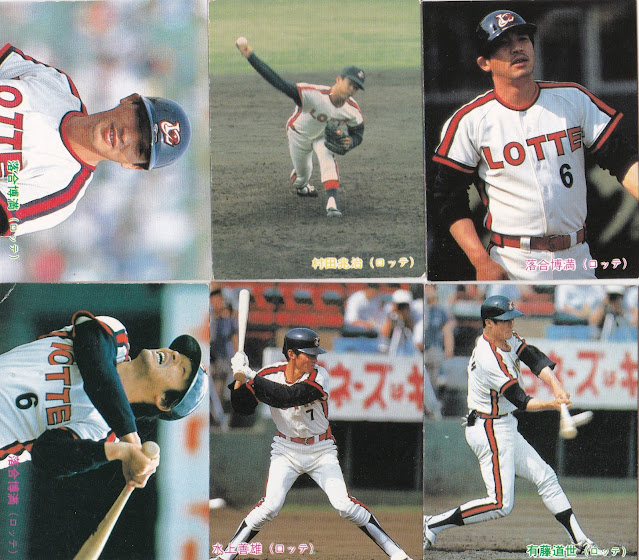
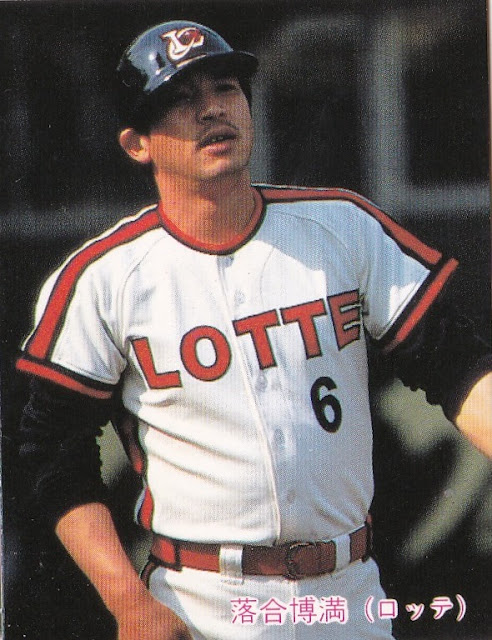
Anyway, the result of the end of the feud was that the 1985 Calbee set was the first in history to feature Orions players.  There were some really important players who thus had their first Calbee card that year.  Notable among them were Hiromitsu Ochiai, probably the best player in NPB during the 1980s who won a remarkable three triple crowns.  He had played his first game in 1979 but it wasn't until 1985 that Calbee collectors got a card of him.  Japanese collectors consider his first card in the set (71) to be his "rookie card", though he actually appeared on cards in Takara sets before 1985. He also appears on a few other cards in other series.


Hall of fame pitcher Choji Murata also has his "rookie card" in this set even though he made his debut in 1968 and was nearing the end of his career in 1985 (and like Ochiai had appeared in Takara and also Yamakatsu sets previously).  He is very famous in Japan for having been the first pitcher to undergo Tommy John surgery (edited to note: he may have been the second), and then making a very dramatic comeback in his career afterwards.

Michiyo Arito is another notable Orion who debuted in the 85 Calbee set. Unlike Murata and Ochiai he isn't in the hall of fame, but he is a member of the Meikyukai with more than 2,000 career hits.  His biggest claim to fame, at least in English language sources, is his appearance as the antagonist in the stories of other players.  He seems to have been a kind of hard headed traditionalist who just plain didn't get along with other people. Towards the end of his playing days he took over as Orions manager and famously decided to trade away Ochiai - by far the best player in the game who had just won the triple crown - because he didn't approve of his independent attitude.  The great Leron Lee, who played 11 years with Lotte as Arito's team mate (and set the career batting average record in NPB) also had some scathing things to say about his managerial style and personality (cited in Robert Whiting's book You Gotta Have Wa).  He was a disastrous manager and the team finished last place in 2 out of his 3 seasons as manager (and only second to last in the other).

Speaking of which, Leron Lee is probably the biggest  victim of the Calbee-Lotte feud since it encompassed almost his entire career in Japan.  For reasons that I don't understand he is the only big Orions star who Calbee didn't give a card in the 1985 set.  In fact they never gave him a card at all - he played until 1987 but doesn't feature in the 1986 or 1987 Calbee sets either despite being a regular (and productive) player right up until his last season.  His brother Leon, who played for other teams, has lots of cards in 1980s Calbee sets but for some reason they never bothered to make one of Leron, which is a massive historical injustice to one of the best players in NPB during that time frame.  I don't know why that happenned - in Whiting's book it is noted that Leron wasn't very well treated by Lotte fans despite being such a great player for them, which may have something to do with it -  but I think it stinks.


Tuesday, October 6, 2020

Calbee's Awesome 1985 Art Contest for Kids


Here is a little pile of 1985 Calbees that I recently picked up.  I have about 200 cards from the 1985 Calbee set which puts me almost halfway to the 465 it has in total, but I'm not seriously chasing it since the vast majority of the remainder are from hyper rare series that are way out of my budget.  

One good thing about the 1985 set though is that there is a pretty big series in it, which also happens to be one of the easier (and thus more affordable) series, that has awesome artwork on the back.  

Calbee had a contest that year in which kids would send in pictures they had drawn of baseball players.  If they won, their picture (along with their name and home prefecture) would go on the back of the player's card.  These are the backs of the 16 cards featured above:

I think there are about 100 cards in the set which have this artwork, these are just a few examples.  

Boomer Wells is looking cheerful:

Kiyoshi Nakahata looks like he is trapped in a Picasso:
Jose Cruz looks like he is grinding his teeth:
Akinobu Mayumi is daringly rendered in profile without any features:
The late Nobuyuki Kagawa's legendary chubbiness is very well captured:

An interesting thing is that at the bottom of all these cards there is a comment from someone called "Yoshimura Sensei" about the artwork.  On Kagawa's for example he/she says "Kagawa is cute. This is a very pleasant picture."

I'm kind of curious about who Yoshimura Sensei was - probably an art teacher of some sort.

These cards are another aspect I like about older Japanese baseball cards in general -  I don't remember Topps or any other US maker having contests like this in 1985.  It must have been so thrilling for these kids to see their pictures on actual baseball cards.

Thursday, June 20, 2019

The 1980s Calbee Sets Ranked by Difficulty


 As I’ve been documenting on this blog over the years, my main (though not exclusive) collecting interests are Japanese Calbee sets from the 1970s and 1980s. These two decades produced radically different Calbee cards.  1970s cards are closer to standard sized and tend to depict scenes from games rather than of individual players.  Though many cards of that era do feature a single player, the back of the card usually focuses more on describing the specific game or scene depicted rather than general biographical information on the player.


In the 1980s that changed radically.  The cards became smaller, about the size of 1950 Bowmans, resulting in the decade being called the “mini card era” among Japanese collectors.  Also the cards moved away from depicting scenes in games and instead adopted the more conventional card depicting a single player on the front and having biographical information about the player on the back.  


The 1980s Calbee sets aren’t quite as popular as the 1970s sets, in part I think because the photography on the 70s sets is a lot better and also because the bigger card size displays them better.  But they do nonetheless remain among the most popular for Japanese collectors, depicting a lot of guys like Ochiai and Randy Bass who didn’t appear on cards from the 1970s.  


The sets vary widely according to how difficult they are to collect.  Compared to American sets from the 1980s they are infinitely more difficult: this was not the junk wax era in Japan and a closer comparison would probably be lie between the 1950s Topps and Bowman sets (on the easy side) and the T-206 set (on the harder side) in terms of difficulty.  Though even this is inaccurate since some years are nearly impossible to complete due to the rarity of some cards and sheer sizes of the sets, while others are actually quite do-able as collecting projects, albeit still challenging (especially if you are outside of Japan).  So here I thought I’d list the sets from the mini card era (1980 to the first series of 1990) in terms of difficulty, starting with the easiest at the top and going to the most difficult at the bottom.


1. 1990 First Series
Overview: This is in a league of its own in terms of ease of collection for three reasons.  The first is its small size – only the first 55 cards of the 1990 set are mini cards, for the upper series they completely redesigned them and the cards of the higher series are effectively a completely different set (though they continue the numbering from 56).  The second is the fact that there are no short printed cards in this series, so there aren’t any individual cards that are insanely hard to find (and expensive) compared to the rest. Finally, having been released in 1990 it seems that more of these cards have survived than ones from earlier in the decade.  There aren’t a lot of them out there but they are a bit easier to find than the cards from the early 80s, and generally can be found in a bit better condition.


My Collection: This is the only mini card set that I’ve been able to fully complete thus far. At about 100 Yen per card it cost about $50 (though that is fancy accounting as there were some doubles produced - if I sold those I could get it down to $50)!


2. 1986

Overview: The 1986 set is significantly harder to complete than the first series of the 1990 set, so there is a huge gap between the #1 and #2 spot on this list, but its definitely the easiest of the sets that encompass an entire year (in contrast to the 1990s minis which are only part of that year’s Calbee card release).  At 250 cards it is a lot smaller than the average set of the 1980s, which helps a lot.  The biggest reason for its relative ease though is that it’s the only full size set that doesn’t have any short printed series of cards: all 250 in the set are equally easy/difficult to find. It does feature the rookie card(s) of Kazuhiro Kiyohara, which used to be quite sought after and expensive, but in recent years his popularity has fallen off a cliff and they don’t command anywhere near as much of a premium as they used to (which is great for set builders).


My Collection: I am about 80% of the way to completing this set, with about 200 out of the 250 cards.  I haven’t had to shell out big money on any of them, I’ve been averaging about 100 Yen per card, so if I keep that up I could conceivably complete this set (in mid grade condition) for about $200-$250 US (though this will require a lot of patience on my part!)


3. 1987

Overview: The 1987 set is noticeably more difficult than the 1986 set, but still ranks among the easier to complete.  The bump in difficulty is explained both by the larger number of cards (382) and the fact that one series (cards 75 to 99) was short printed and is more difficult and expensive to complete than the rest of the set. These make it more difficult than the 1986 set, but two other factors make it easier than most other 1980s sets.  The first is that 1987 was a good year for baseball popularity in Japan, the Giants doing well that year, which I’ve heard boosted the sales of Calbee baseball chips that year and resulted in a somewhat higher supply of these cards being out there.  Second is the fact that while it does have a short printed series, that series is not super rare like some in other sets are.  The premium you pay for them is pretty modest and they can be found.


My Collection: I’m almost finished this set, with 378 out of 382 cards down.  The only 4 I have remaining are from the short printed series.  I’ve probably averaged about 100 yen per card for the regular cards and more like 300-400 Yen per card in the short printed series (though some of those I obtained through a trade).  So I’m looking at having spent about $400-$500 to complete this one, in upper mid grade condition (probably averages about EX).


4. 1988

Overview: For the most part collecting the 1988 Calbee set isn’t much different than collecting the 1987 or 1986 set: the cards cost about the same and are about as easy/difficult to find.  Number wise it lies between the two, at a manageable 329 cards.  The thing that puts it lower down the list though are the short printed cards, which there are a number of.  These are significantly more difficult to find than the 1987 short printed series and prices reflect this: singles in the short printed series usually sell from 30$ to $100 each on Yahoo Auctions.  There are three main blocks of short printed cards in this series.  The first are cards 101 to 115, the second are cards 251 to 265 and the final ones are cards 305 to 329.  Interestingly only the first and last of those blocks are priced highly in both Engel and my (now out of date admittedly) copy of Sports Card Magazine.  I’ve been able to determine that the cards from 251 to 265 are rare both by the fact that I don’t have any and that I’ve seen cards from those numbers sell at auction in about the 3000 Yen range, which is way out of whack for regular cards in that set.  The cards in the final series (305 and over) seem to be the most expensive and generally sell for over 5000 Yen each.  Its worth noting that there are two versions of card 305, one of which features a “fine play” with borders looking like film strips, and the other featuring Kiyohara.  The Kiyohara version is the more valuable of the two.


My Collection: I have about 70% of this set complete, but that is almost entirely made up of cards from the easier to find series. I only have 4 of the short printed cards, and none of them from the most expensive series above 305.  I’ve probably averaged about 100 Yen per card, but with the short printed cards selling for so much you’d probably be looking at spending nearly 1000$ US to complete this sucker, more than what you’d likely pay for the 1986. 1987 and 1990 first series combined.  Those short prints are wallet killers!


5. 1985

Overview: The 1985 set is a tough one.  At 465 cards it is a bigger set than the later 80s sets higher up the list.  It also has some hard to find short printed cards that are extremely expensive, notably cards 441 to 465, which have gold borders and usually sell for 5,000 Yen or so each.  Cards 276 to 325 are also short printed, though not as expensive.  One other thing that sets this one apart is that even the singles in the easier to find series are harder to find than they are for the sets of the late 1980s.  The non short printed cards in the 1986 to 1990 sets are, while fairly scarce, notably easier to find that the pre-1985 sets.  I’m not sure why 1985 is the drawing line for this, perhaps baseball chips were a more popular snack after that year.  You can see evidence of this on Yahoo auctions, despite their being more cards in the set a search for “1985” in the Calbee section only gets you 242 hits, while a search for “1988” gets you 909.  The set is also notable for having Choji Murata’s rookie card, one of the earlier examples of a higher priced (about 5000 Yen) rookie card in a Japanese set. It also has Warren Cromartie’s first Japanese cards. 


My Collection: I have a little over 100 cards from this one so I’m nowhere near completing it.  I don’t have any of the short printed ones either. I’ve probably averaged a little over 100 Yen per card on this one, though again that doesn’t include any of the valuable ones.  You’d definitely be looking at around $1500- $2000 or so to finish this one and it could take decades to track them all down.


6. 1982

Overview: This is a big set, 651 cards, and was the first of a three year run of Calbee sets with more than 650 cards.  Confusingly it is numbered to 751 because 100 cards (452-551) don’t exist! It has three short printed series (201-250, 351 – 401 and 702 – 751) which are quite expensive.  The cards from the rest of the set aren’t too hard to find, but there are a lot of them which makes it much more challenging than the 1985 set.  Its also quite hard to find the cards in this set in nice condition (most of the ones you find are in mid grade or lower). Its notable for having the rookie card of Tatsunori Hara. 


My Collection: I have over 100 cards for this set, so I’m not very far into it.  None of the ones I have are from the short printed series and most of the ones I have are mid to low grade.  This set will probably set you back about $5,000-$6,000 if you try to put it together, it’s a doozy.


7. 1984


Overview:  This set is a really hard one to collect.  At 713 cards it is massive, the biggest Calbee set of the 1980s and almost triple the size of the 1986 set.  Its also got a lot of extremely expensive short printed cards.  The entire run from card 591 to 690 – 100 cards! – is short printed and every one of those is going to set you back $30-$50 each if you can find them (at the moment not a single one is available on Yahoo auctions, they only show up from time to time).  Another 90 card block, from 401 to 490, was also short printed so overall you are looking at nearly 200 expensive short printed cards to finish this set.  As with the 1985s, even the non-short printed cards from this set are harder to find than the ones in the sets from the late 1980s.  This is especially the case if you are looking for them in upper grade, probably 90% of the early 80s Calbee cards are in mid grade (vg-ex) or lower (the ratio is probably more like 50% with late 80s cards).  The set is notable for the fact that most cards in it have a unique design that is different from the standard full bleed photos of other 80s Calbee sets.

My Collection: I have about 250 cards from this set, which means I am over 1/3 of the way there!  But I only have 2 of the short printed cards, and I don’t think I’ll be making any headway on them in the near future.  I’ve averaged about 100 Yen per card on this set, but its in lower grade condition than my later 80s Calbee sets are (probably averages about vg or vg-ex).  Completing this one could easily run $6,000- $7,000 because of all those short printed ones and is beyond my means (barring an unexpected lottery win).


8. 1983

Overview: At 710 cards this is one of the bigger 80s sets, almost the exact same size as the 1984 set.  It has some very hard to find short printed series, particularly cards 401-450,  501-550 and 601 to 700 – between the two of those you have about 200 Short printed cards that sell for 3,000-5,000 Yen each to track down.  In addition to that you have 10 cards that aren’t numbered which are the hardest to find.  I’ve never seen any on Yahoo Auctions, my old SCM lists them at 6000 Yen each but I suspect they would sell for more (prices on the short printed 1980s cards have risen quite a bit in recent years, my SCM is from 2010).  The set is notable for having the first cards of Randy Bass.


My collection: I have about 300 cards from this set so I’m actually getting close to the halfway point.  As with my other early 80s sets though I am severely short on the rare ones: I only have one of the short printed cards.  I probably averaged about 100 Yen per card for the ones I have, but like my 1984s the condition of my set is significantly lower than my late 80s sets (probably vg or vg-ex).  I guess this would be a $6,000-$7,000 project if I were to seriously pursue it. 


9. 1981


Overview:  This is a tough one.  At 450 cards its about average size, and it actually only has one hyper rare short printed series (201-250).  But what sets it apart and puts it so low down this list is that the non-short printed cards are also quite hard to find, much more so than even the 1983s or 1984s.  There are no easy to find lots for this set – every one out of those 450 cards is going to be one you have to track down and pay something for.

My collection: I have about 25 cards from this set, none of them from the short printed series. I paid about 300 Yen each for them, and that was quite a deal.  This would be about a $6,000 to $7,000 project if you were to ever try it, not for the faint of heart.


10 . 1980


Overview: At this point down the list its getting harder to justify differences in rank since they are all so damned hard, but the 1980 set is one that definitely belongs somewhere down here.  It does have one advantage, which is its small size.  At 296 cards it’s the second smallest Calbee set of the 80s after the 1986 set.  Technically speaking you could even shave 96 cards off that list though since the first 96 are actually bigger sized cards more like the 1970s Calbees, for some reason they changed the design mid year to the mini card style (much like they would ditch the mini cards half way through the 1990 set a decade later), but for our purposes we can treat it as a single set.  Its “easy” points end there though.  About half the cards (basically everything from 49 to 196) are short printed and extremely expensive.  And actually even the non-short printed cards are pretty rare, singles from this set across the board are the hardest of any from the 1980s to come by. 


My collection: I only have two cards from this set so it’s the 1980s set I am furthest from completing.  Even the commons from the non-short printed series usually sell for 500-1000 Yen each, and the short printed ones for many times that much, so despite its relatively small size this set is probably going to be a $5,000- $6,000 endeavour (maybe more) that will take years of work.  I am not actively pursuing this set due to the sheer cost of it right now.


11.  1989


Overview: I’m a bit torn about putting the 1989 set as the most difficult because depending on how you define it, it might be closer to the 1988 set in difficulty much higher up this list.  It’s a 414 card set and most of the cards are about as easy/difficult to find as cards from other late 80s Calbee sets.  But cards numbered 111 to 220 were short printed and sell for a premium similar to what the short printed series in the 1988 set sell for.  Those aren’t the real deal breaker that drops the 1989s to the bottom of the list though.  That belongs to the last cards in the set, 391 to 414.  These are short printed, but so short printed that nobody seems to know if they were ever even distributed in packs.  They are kind of legendary among Calbee card collectors and so rare that they are the only 1980s Calbee cards that SCM refuses to put a price on since there are so few transactions involving them.  I’ve never seen one come up for auction on Yahoo Auctions.  So if you include those 23 cards in the 1989 set, it’s the most difficult.  Without them this set would probably be between the 1988 and 1985 sets in difficulty.  The set is notable for having cards of Cecil Fielder, the only Calbee set to do so.


My Collection:  I have about 60 cards from this set, it’s the only late 80s Calbee set I’ve never made a serious attempt to collect mainly because those mysterious super short printed ones discourage me from doing so.  Most of the cards in the set are about as easy and cheap to get as 1988 or 1987 Calbees, but I can’t speculate on how much a full set would cost.  Those hyper short printed ones could easily sell for thousands of dollars each, making this the most expensive 1980s Calbee set out there if you were to include them.

Friday, April 17, 2015

Fun Stuff: A big pile of 1985 Calbees


Among my favorite recent purchases has been a stack of 52 cards from the 1985 Calbee set.  This is one set I only had a handful of cards for so I figured this would be a good way to get a start on building the whole thing.

The lot had some beauties in it, like this card with an excellent in action photo of the Iron Man Sachio Kinugasa:

Or Randy Bass in those awesome 80s Tigers uniforms with the white helmets:


What surprised me most on receiving these cards (they were a Yahoo Auction purchase) was the condition.  Every one of them looked brand new like they had just come from the bag.  This almost never happens with Calbee cards from before the mid-1990s, especially not in big lots.  I had bought them assuming they were the typical somewhat beat up lot that usually appears (the photos were a bit out of focus and the seller, who doesn't specialize in cards, didn't mention the condition int he description).

This is what the stack (left) looks like in comparison to a typical stack of 80s Calbee cards in my collection (right):

One thing I really like about the 1985 set which sets it apart from others is that a lot of the cards have hand drawn artwork of the players that was sent in by kids on  them.  These were winners of a contest to draw the best picture of each player and I think it is absolutely fantastic that Calbee did that.  Not only are the color drawings a big improvement on the normally bland card backs of their typical 1980s sets, it is also quite endearing that they would do that.  Its something it would be hard to imagine a card company doing today.